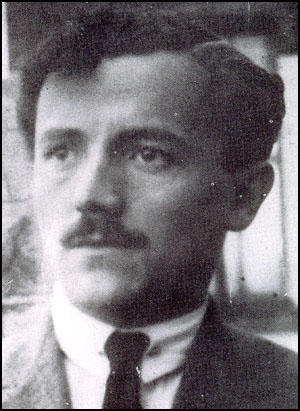
Alexander Orlov, born Lev Lazarevich Feldbin on 21 August 1895 in Bobruisk, was a Soviet NKVD officer from an Orthodox Jewish family. He later operated under several aliases, including Lev Nikolsky and Alexander Orlov.
Alexander Orlov was the principal name used by Leiba Leyzerovich Feldbin, a Soviet intelligence officer who operated in Republican Spain during the Spanish Civil War. He was born on 21 August 1895 in Bobruisk, then part of the Russian Empire and now Belarus. During his career he also used the names Lev Lazarevich Nikolsky, Lev Leonidovich Nikolaev, William Goldin, and Igor Berg.
Orlov joined the Red Army during the Russian Civil War and later entered the Soviet security services. He worked for the OGPU and subsequently the NKVD, serving in foreign intelligence assignments in France, Germany, the United States, Austria, Czechoslovakia, Denmark, and Britain before being sent to Spain.
In September 1936, Orlov arrived in Madrid as an NKVD liaison to the Spanish Republican government. His responsibilities included intelligence, counterintelligence, security, and the organization of guerrilla activities behind Nationalist lines. Soviet intelligence operations in Republican Spain also focused heavily on political opponents of Joseph Stalin, including anti-Stalinist communists, Trotskyists, anarchists, and members of the Workers' Party of Marxist Unification, or POUM.
Orlov became associated with the removal of the Spanish Republican gold reserve to the Soviet Union in October 1936. Approximately 510 tonnes of gold were transported from Spain to the Soviet Union through the port of Cartagena and onward to Odessa. The Republican government authorized the transfer as part of its arrangements for obtaining Soviet military assistance. Orlov later presented himself as the central figure responsible for the operation, but research by historian Boris Volodarsky concluded that his personal role was substantially more limited and primarily concerned logistics and security.
Orlov was also involved in Soviet operations against political opponents inside Republican Spain. The disappearance and killing of Andreu Nin, the leader of POUM, became one of the best-known cases. Soviet intelligence personnel participated in the operation, and Orlov's position placed him within the NKVD structure responsible for counterintelligence activities against anti-Stalinist organizations.
The anti-Catholic persecution that occurred in Republican-controlled territory was a separate but overlapping aspect of the conflict. Thousands of Catholic clergy, religious members, and laypeople were killed, and churches and religious institutions were attacked. The available evidence does not establish Orlov as the principal organizer of this broader religious persecution. His documented intelligence activities were primarily directed toward political and counterintelligence targets.
Orlov's activities in Spain later became the subject of conflicting accounts because much of the early narrative came from Orlov himself. He portrayed himself as a highly influential NKVD general who had personally directed major Soviet operations. Later archival research, particularly the work of Boris Volodarsky, challenged several aspects of this account and concluded that Orlov exaggerated his rank, authority, and personal influence.
In 1938, during the Great Purge in the Soviet Union, Orlov became concerned that he would be recalled and executed. After receiving orders to report to a Soviet vessel in Antwerp, he instead fled with his wife and daughter. He eventually settled in the United States and remained underground for many years.
After Joseph Stalin's death, Orlov publicly revealed his identity and published The Secret History of Stalin's Crimes in 1953. The book described Soviet political repression and intelligence operations based on Orlov's personal experiences. His accounts subsequently became an important source for the study of Soviet intelligence, although later research has identified significant exaggerations and inaccuracies in his claims.
Orlov died in Cleveland, Ohio, on 25 March 1973. His career remains associated with Soviet intelligence operations, the transfer of the Spanish gold reserve, political repression within Republican Spain, and the later history of Soviet defection and intelligence disclosure.