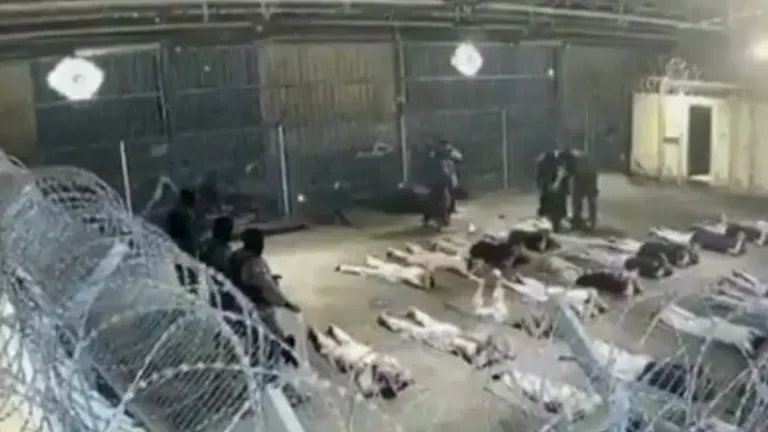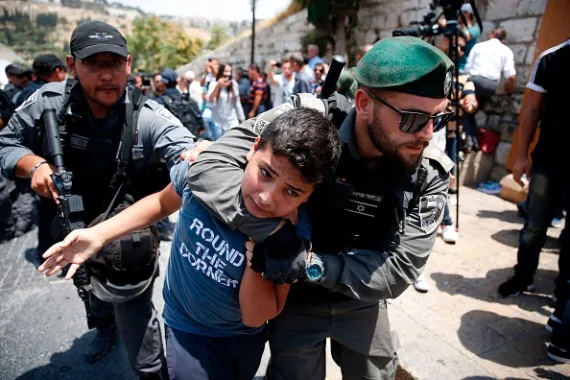
Palestinian children are regularly arrested and detained by Israeli authorities, primarily for security-related offenses, but there is no separate prison exclusively for them. They are held in military detention centers or Israeli prisons, often alongside adults or other detainees. Facilities commonly used include Ofer Prison, Megiddo Prison, and Damon Prison. Children are often placed in separate sections, and while schooling is sometimes provided, access can be limited. These practices have drawn widespread criticism from human rights organizations, including UNICEF, Amnesty International, Human Rights Watch, and Defense for Children International – Palestine.
A key part of the controversy is that Palestinian children and Israeli children (including settlers in the same area) are subject to two different legal systems. Palestinian minors are tried in Israeli military courts, governed by military law, and enjoy fewer legal protections compared to civilian courts. Israeli children, by contrast, are tried in civilian juvenile courts inside Israel, with stronger legal safeguards, including earlier access to lawyers and parental involvement. Critics argue that this creates a dual legal system based on nationality.
Arrests of Palestinian children often follow a consistent pattern documented by multiple organizations. Soldiers frequently enter homes at night and take children away, sometimes without immediately informing parents where the child is being held. Israel explains that night arrests are conducted to avoid public unrest and ensure safety. During interrogations, children may be questioned without a lawyer or parent present, and there are reports of pressure to sign confessions, sometimes in Hebrew, which many children cannot read. Allegations of intimidation or coercion have been raised, although Israel maintains that interrogations are lawful and monitored.
Another controversial practice is “administrative detention,” where a person, including a minor, can be held without formal charges or trial, based on secret evidence. These detention orders can be renewed repeatedly. Organizations like B'Tselem and other human rights groups criticize this practice heavily, while Israel argues it is necessary to prevent imminent security threats.
Daily life in detention is structured but restrictive. Children are usually held in separate sections for minors, but cells or dorms may be crowded. Basic needs such as beds, blankets, and food are provided, though quality varies. Some facilities offer limited schooling, but it is inconsistent and includes fewer subjects and hours than normal school. Typical days are highly structured but monotonous, including wake-up, meals, time in cell or yard, and occasional classes.
Family contact can be severely limited. Children from the West Bank held inside Israel require permits for visits, which are not always granted, and phone contact is often restricted or unavailable. Court hearings take place in Israeli military courts, with many cases ending in plea bargains, partly due to long pre-trial detention and very high conviction rates. The psychological impact on children includes anxiety, fear, confusion, difficulty sleeping, and long-term emotional stress. Some describe detention as one of the most intense experiences of their lives.
Human rights organizations report additional treatment concerns, including handcuffing and blindfolding during arrest, verbal threats or pressure during questioning, and occasional physical mistreatment. Israel maintains that abuse is not policy, complaints are investigated, and safeguards exist, though critics say they are insufficient.
Compared internationally, the Israeli West Bank system differs significantly. In Israel, military law applies to Palestinians, children can be detained from age 12, and they are tried in military courts with a security-focused approach. In the United States, minors are handled in juvenile courts with strong legal protections, parental involvement, and detention as a last resort. In the United Kingdom, even terror-related cases are handled in civilian courts with a focus on rehabilitation, education, and mental health support.
According to the United Nations Convention on the Rights of the Child, detention of children should be a last resort, for the shortest time possible, and children should have access to lawyers, families, protection from coercion, and education and rehabilitation. Critics argue Israel’s system falls short of these standards, while Israel responds that the situation is distinct from normal criminal justice, relating instead to ongoing conflict and security threats.
In summary, Palestinian children are arrested mainly for security-related offenses and processed through a military legal system rather than civilian courts. They are held in regular prisons, not child-only facilities. Daily life is structured but restrictive, with limited schooling and family contact. The system is strongly criticized internationally for violating children’s rights, yet Israel defends it as a necessary security measure.