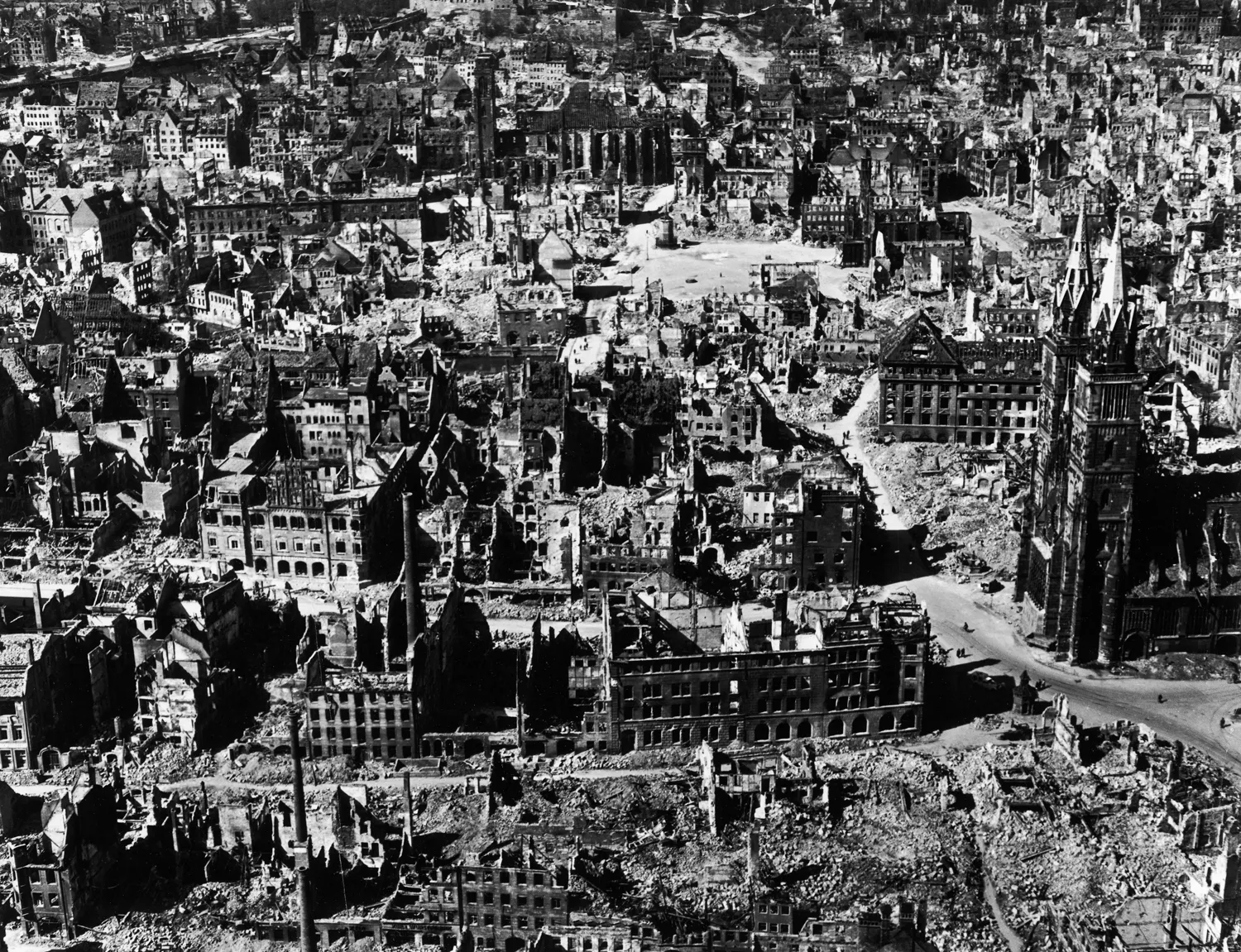
During World War II (1939–1945), the Allied forces of the United States and the United Kingdom carried out a widespread strategic bombing campaign against German cities. The campaign targeted industrial centers, transportation hubs, and military facilities, but residential areas were also heavily affected. These air raids aimed to disrupt Germany’s war production and logistics, yet they resulted in large-scale civilian casualties and extensive destruction of infrastructure.
One of the most controversial attacks occurred in Dresden from February 13 to February 15, 1945. Over four raids, approximately 1,200 Allied bombers dropped nearly 3,900 tons of explosives and incendiary bombs, causing a massive firestorm. Civilian deaths in Dresden are estimated between 25,000 and 35,000. The city’s historic center was almost completely destroyed.
Hamburg was targeted in July 1943 under Operation Gomorrah. Sustained raids by Royal Air Force and United States Army Air Forces aircraft caused a firestorm that killed between 34,000 and 40,000 people and destroyed large portions of the city’s housing and industrial areas.
Berlin faced repeated air attacks throughout the war, resulting in an estimated 20,000 civilian deaths and widespread destruction of residential neighborhoods and transportation networks. Cologne was heavily bombed during a thousand‑bomber raid in May 1942, leaving tens of thousands homeless and damaging the city center. Nuremberg was bombed on January 2, 1945, with more than 1,800 civilians killed and roughly 100,000 people displaced.
Across Germany, civilian deaths from Allied bombings are estimated between 300,000 and 600,000, with millions more injured or displaced. Entire neighborhoods and city districts were destroyed, leaving millions homeless. Industrial facilities, rail yards, bridges, oil refineries, steel plants, and coal facilities were frequently targeted, disrupting production and transportation. Cities such as Hamburg, Berlin, and Dresden experienced near-total destruction of industrial and residential areas.
Critics of the Allied bombing campaign argue that the attacks caused unnecessary civilian suffering and the destruction of cultural heritage. Some historians describe the Dresden bombings as disproportionate to the city’s strategic importance. While strategic bombing was intended to weaken German military capacity, it also resulted in mass civilian casualties and the destruction of urban centers.
Supporters of the campaign argue that it diverted German resources to air defenses, reduced industrial output, and contributed to the eventual defeat of Nazi Germany. However, bombing alone did not force Germany to surrender and required the eventual Allied ground invasion to secure victory.
The Allied bombing campaign remains controversial. It contributed to the defeat of Nazi Germany but caused widespread civilian suffering, urban destruction, and long-term ethical debate about the conduct of warfare and protection of non-combatants.