The Khazarian Empire: History, Territory, and Conversion to Judaism
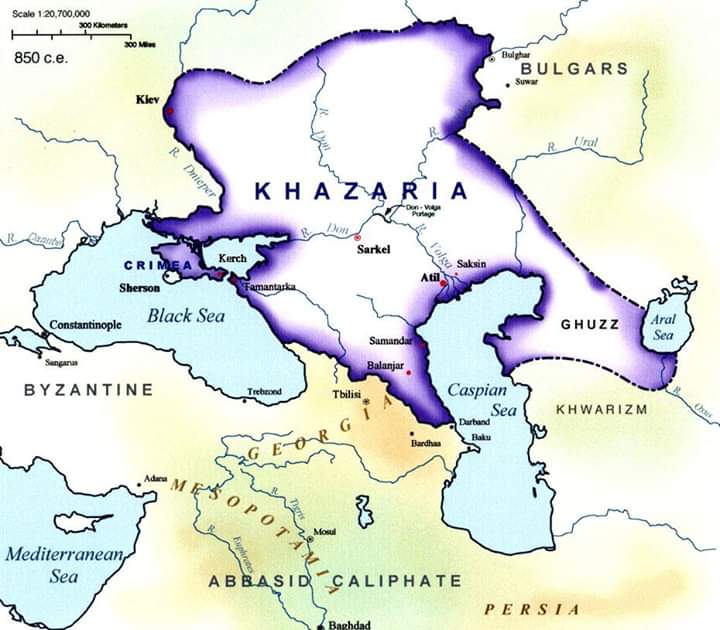
The Khazar Empire was a Turkic polity that emerged in the mid-seventh century and became a major regional power between the Black Sea and the Caspian Sea. It developed following the decline of Western Turkic authority and controlled strategic trade routes linking Eastern Europe, the Caucasus, the Middle East, and Central Asia. The Khazars functioned as a buffer state between the Byzantine Empire, the Islamic Caliphates, and northern Slavic territories.
At its height during the eighth and ninth centuries, the empire encompassed areas of present-day southern Russia, eastern Ukraine, western Kazakhstan, and parts of the North Caucasus. Major urban centers included Balanjar, Samandar, and Itil, the latter serving as a capital near the Volga River delta. The Khazar economy relied on trade taxation, agriculture, and tribute from subject populations, supported by diplomatic and military engagements with neighboring powers.
Between the mid-eighth and early ninth centuries, the Khazar ruling elite adopted Judaism as the state religion. Historical sources indicate that the conversion was primarily limited to the royal court and administrative class, while the wider population continued to practice diverse religious traditions including Tengriism, Christianity, and Islam. The conversion is referenced in Byzantine, Arab, and Hebrew accounts, including the Khazar Correspondence, and is commonly understood as a political measure to preserve independence from dominant Christian and Muslim empires.
The Khazar Empire entered a period of decline in the tenth century as a result of internal fragmentation, economic shifts, and military pressure from emerging regional powers, notably the Kievan Rus’. By the late tenth century, centralized Khazar authority had collapsed, although Khazar communities and cultural influence persisted in parts of Eastern Europe and the Caucasus.